

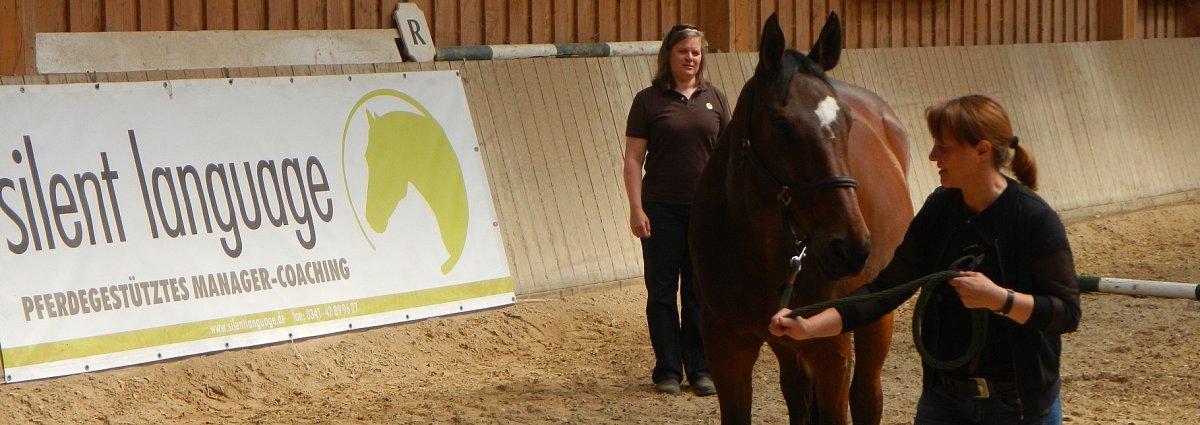
Three Moments of Our Trainings
Three Practical Examples
How horses as co-trainers open new perspectives
Every encounter with a horse is unique.
And yet, there are recurring situations in which horses act as mirrors and catalysts – clear, honest, and often surprisingly insightful.
The following examples give you an impression of how equine-assisted coaching can impact leadership in very different ways.
1. Ms. Müller – When Behavior Is Reflected
A managing director was on the verge of ending his collaboration with his assistant.
The working relationship was tense, shaped by the perception: uncooperative, difficult, exhausting.
In the coaching session, a horse – “Raffaello” – symbolically took on the role of this employee.
Together, they completed a structured exercise course reflecting everyday work situations.
The result? Frustration.
“The horse is just as difficult as my assistant.”
The key insight came quickly:
How can a horse display behavior it cannot possibly know?
The realization was clear – and striking:
The horse was not reacting to the assistant.
It was reacting to him.
To his posture, his inner tension, his expectations.
In subsequent exercises, the client developed new approaches to handling the situation.
A few weeks later, he consciously chose to continue the collaboration – with a completely new quality.
2. Sales Conversation – Technique or Relationship?
A sales team wanted to improve their impact in client interactions.
The exercise:
A course symbolically represented the product.
The salesperson led the horse – while the “client” (a blindfolded colleague) held on to the horse.
The salesperson completed the task technically perfectly.
However, the client felt insecure and not truly engaged.
Why?
The focus was on the task – not on the person.
In the second round, roles were reversed:
The “client” led the horse blindfolded, while the salesperson gave instructions.
Suddenly, connection emerged.
The client felt safe, seen, and guided.
The insight:
Successful sales is not only about expertise – but about genuine human connection.
The horse makes this quality immediately visible.
3. Top Management – Making Team Dynamics Tangible
Five leaders, newly working together, wanted to strengthen their team spirit.
They stood in a circle with a horse in the center.
Silent. Still. Fully present.
The remarkable aspect:
This horse is highly sensitive to uncertainty and lack of clarity – it would normally create distance.
But here, it stayed.
Calm. Relaxed. Connected to the group.
The impact was clear:
A team that radiated clarity, presence, and shared alignment.
Without a single word.
What All These Examples Have in Common
Horses do not respond to roles, titles, or words.
They respond to authenticity.
They make visible what lies beneath the surface –
in leadership, communication, and collaboration.
And this is exactly where their strength in coaching lies:
They open new perspectives – directly, honestly, and sustainably.